Your electricity bill explained
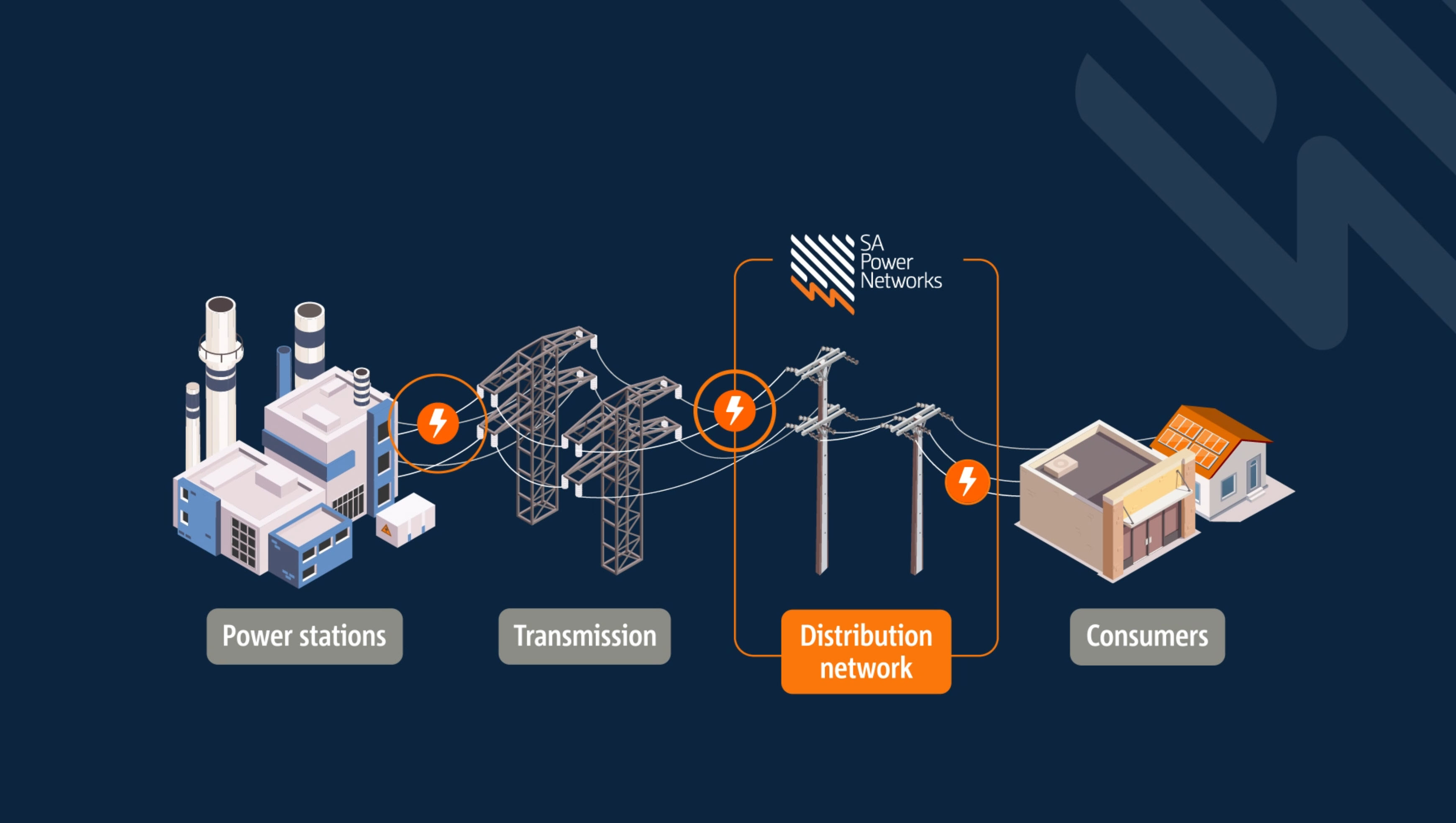
SA Power Networks is responsible for the distribution network - the poles, wires and substations that safely and reliably deliver electricity to and from homes and businesses across South Australia. We do not set the retail prices customers pay for electricity.
Your retail bill has two main parts: the price you pay for the electricity you use, which is measured in kilowatt hours (kWh), and the charge to supply electricity to your home.
The supply charge
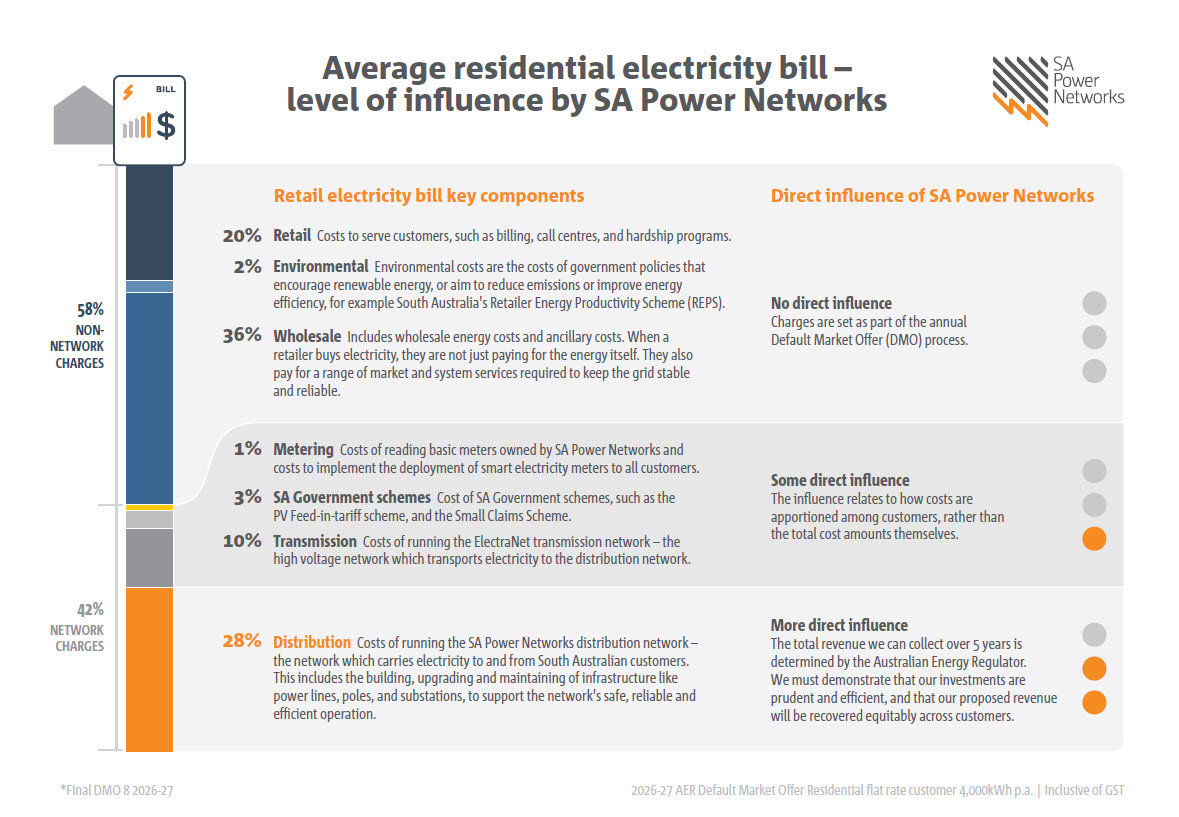
SA Power Networks’ distribution charge is only one component of the supply charge on your retail bill. The supply charge comprises:
- Distribution costs (SA Power Networks' network charges)
- The cost of generating electricity
- Transmission costs (moving electricity from generators across the transmission network run by ElectraNet)
- SA Government charges
- Metering charges
- Your retailer's operating costs
We charge your electricity retailer our network tariff. Your retailer then determines how all these costs are reflected in your retail bill.
Some retailers may apply a higher supply charge with lower usage rates, while others may structure their pricing with a lower supply charge and higher usage rates.
What we charge
Our network charges in real terms (when adjusted for inflation) are lower today than they were more than 25 years ago. For the average customer, our network charges are approximately $13 per week, representing less than one-third of a typical electricity bill.
This supports the maintenance, operation and ongoing investment in South Australia's electricity distribution network, which transports electricity safely and reliably to and from more than 950,000 homes and businesses through more than 400 substations, approximately 645,000 Stobie poles and more than 90,000 kilometres of powerlines.
The amount we are allowed to charge is determined by the independent Australian Energy Regulator (AER) every five years. We have to demonstrate that we are investing those funds prudently and efficiently.
You can learn more about our network tariffs for both residential and business customers here: Tariffs we charge to distribute your electricity
Retail tariffs
The AER sets a benchmark price for electricity for Residential and Small Business customers. This is called the Default Market Offer (DMO). Any changes in the DMO take effect on July 1 each year.
The DMO is a safety net for household and small business customers. It is used to make a standing offer, which is the basic electricity supply contract a retailer will issue to customers who have not signed up to a commercial market offer. The pricing and structure of market offers may be better suited to meet the customer’s energy needs, and so the DMO is not necessarily the cheapest or most suitable offer available.
Retailers will compare their market offers to the DMO price and may refer to it as the benchmark or comparison price. But retailers then design their offers differently. Some offers may have a higher supply charge and lower usage charges, while others may have a lower supply charge and higher usage charges.
A higher supply charge does not mean that SA Power Networks’ charges have increased. It just reflects the way the retailer has structured the offer.
Two common types of retail offer are:
- Single rate offers
- Time of use offers
These offers can be based on the type of meter you have. A basic meter is unable to record what time of day energy is used, and so you can only access a single rate offer.
If you have an interval meter which can record those times, then you can access a time of use offer.
Time of use retail offers charge different prices for using energy at different times of day.
| Peak | Off-peak | Solar sponge |
|---|---|---|
|
Generally apply at the time of day when there is the highest electricity demand, and so the rates are higher. This is often in the early morning and evening. |
Apply at times of lower demand, typically overnight. These rates are lower and can benefit those who are able to move some of their electricity usage to occur during these times. |
Some off-peak rates might also be referred to as solar sponge rates. These apply during the daytime when there is more electricity available from renewable energy. These rates are typically the lowest priced and can benefit those who are able to move some of their electricity usage to occur during these times. |
Individual retailers will make their own decisions about when they apply peak and off-peak rates. They might also name them different things.
An Australian Government initiative has also introduced the Solar Sharer Offer (SSO). This is a regulated energy offer that some retailers will make available, which provides eligible households with 3 hours of free electricity in the middle of every day to soak up extra solar energy in the system.
Before deciding whether an SSO is right for your circumstances, you need to think about when you use electricity. The SSO may be beneficial if you can use more electricity during the free-power period in the middle of the day. However, the savings might be offset by other charges, such as the daily supply charge or higher usage rates for peak and off-peak times. Read more about the Solar Sharer Offer.
If you have concerns about your bill
If you're concerned about your electricity costs, we recommend:
- Contacting your electricity retailer to ask whether a better plan or offer is available. Your bill will include information about other plans offered by your current retailer, which could be better for you.
- Confirming with your retailer what rates they are applying to your electricity use at different times of the day. This information should be detailed on your bill.
- Compare retail offers from different retailers using the Australian Government’s Energy Made Easy website. This is a free and independent comparison service for residential and small business customers which can compare offers based on your individual circumstances. See video below.
- If appropriate for your circumstances, consider energy efficiency measures, solar or battery installation to help optimise your electricity usage.
- Access the SA Government’s free Energy Advisory Service.
Learn more about taking advantage of time of use in Your Energy Choices Add Up.
Learn more about our role.
Energy Made Easy video
View the video below to learn how to use the Energy Made Easy comparison website to compare electricity plans for residential customers.
Financial hardship
If you’re having trouble paying your power bill, contact your retailer as soon as you can. All retailers are required to offer payment plans or assistance when unforeseen circumstances arise, such as chronic illness or loss of income.
The South Australian government also has a number of schemes and support services:
- Energy bill concessions
- Help paying energy bills
- Affordable SA Resource hub for addressing affordability challenges in South Australia.
Free, independent and confidential financial counselling is also available through the National Debt Helpline and the South Australian Financial Counsellors’ Association (SACFA). Financial counsellors can help you understand your options, negotiate payment arrangements and access support services.
- National Debt Helpline: 1800 007 007 or http://www.ndh.org.au
- SAFCA: http://www.safca.org.au