Cowell community meeting: What we heard and what happens next
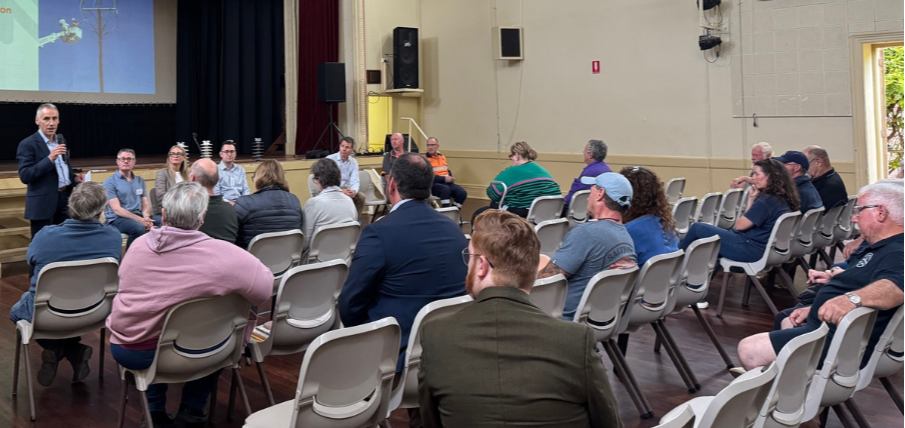
On Monday 2 March, around 30 Eyre Peninsula community members joined us at the Cowell Institute for a discussion about recent outages linked to insulator pollution.
The regional impact of insulator pollution has been significant, with the Cowell area one of the hardest hit. Many who were in the room have now experienced this issue for two summers.
The community shared a wide range of concerns, experiences and ideas. The discussion was open, detailed and at times emotional, reflecting how deeply the recent reliability issues have affected people’s lives.
Listening to those firsthand accounts reaffirmed why addressing this issue – and doing so with urgency – remains our highest organisational priority.
Acknowledging where we are
CEO Andrew Bills acknowledged that the level of reliability currently being experienced by parts of the Eyre Peninsula is not acceptable.
We understand the frustration and the significant impact the outages have had on people. This is why we’ve been meeting with regional communities to hear their experiences, and why we’re doing everything possible to resolve the issue as quickly and safely as possible.
Chief Operating Officer Mark Vincent outlined the scale of the issue and walked through the operational response. He detailed the measures implemented so far, as well as the longer-term actions we’re looking at to improve network reliability.
Chief Customer and Strategy Officer Jess Morris discussed how we’re working to improve the way we communicate with customers, so information is timely, clear and useful. She also highlighted the importance of community feedback in helping us understand where we need to improve.
What we heard from you
The majority of the session was devoted to questions, concerns and ideas from those in attendance.
Key themes included:
The impact of outages
Community members described the cumulative impact of six weeks of outages on sleep, stress, and disruption to business and household tasks. They highlighted significant health, safety and lifestyle effects, particularly for older residents and those reliant on medical devices such as sleep machines.
Hearing these experiences reinforced why resolving this issue remains our highest organisational priority.
Penalties and compensation
There were several questions about penalties on SA Power Networks for poor reliability, and where funds go. We confirmed SA Power Networks has been penalised $10 million to date, to be returned to customers through the Service Target Performance Incentive Scheme (STPIS).
Customers also raised concerns about appliance damage, food loss, and the lack of a clear compensation pathway. We communicated that Guaranteed Service Level payments would apply.
We also advised that we have been in discussions to explore coverage under the Small Claims Scheme with the State Government and that we would communicate further details when we learn more.
Our response and expectations
Customers challenged both current measures and those not yet deployed, particularly following recent rain.
We emphasised that work to address the insulator issue in the Cowell area will be completed before next summer. Several comments reflected frustration and the expectation that maintaining reliability is our responsibility.
We acknowledged this and outlined how we are testing, scaling and implementing safe, viable solutions informed by field experience, technical expertise and learnings from other networks. This includes a controlled South Australian trial of silicone spraying for insulators – an approach successfully used by Western Power in WA.
The network and maintenance
Customers sought clarity on network age, maintenance practices, and asset renewal. We outlined:
- Cowell is supplied by a single 33kV line from Cleve, approximately 45km away, with no redundancy or backup supply (e.g. from Arno Bay).
- The line was upgraded from 11kV in 2008, which included the installation of lightning-resistant insulators.
- While reducing lightning issues, these insulators are affected by residue build-up and will be replaced.
- A new silicone insulator has been trialled on Lower Yorke Peninsula.
- Local powerlines are inspected every five years, with annual helicopter inspections focused on fire-start risk.
- Over the past three years, Cowell power outage causes were:
- Insulator pollution: 48%
- Vehicle hit pole: 26%
- Equipment failure: 15%
- Lightning: 11%
Communication and community involvement
There was strong interest in a detailed plan and timeline for upgrades and remediation once finalised, which we confirmed will be shared.
Attendees emphasised the need for multiple communication channels beyond social media and noted that QR-code and ticket registration processes may have reduced attendance. Some residents also preferred the term “residue” or “build-up” rather than “pollution” to avoid negative regional connotations.
What we’ve implemented
This summer, we have accelerated several initiatives across affected regions. This includes:
Mobile generation
We have installed mobile generation in Cowell in late February to strengthen supply while we continued other remediation work. This will remain in place – with crews on standby – until we’re confident that the issue has been resolved this season.
Increased washing and targeted replacement
Throughout January and February, we undertook an extensive washing program of the worst-affected insulators, resulting in a considerable reduction of interruptions. Together with recent heavy rainfall we believe the risk of further interruptions from insulator pollution this season is very low.
In some cases, washing alone is not sufficient – particularly where insulators have been degraded by repeated flashovers. Where this is identified, we’ve prioritised targeted replacement.
Helicopter washing
We have started trialling using helicopters for washing large sections of the distribution network more efficiently and with considerably less impact on customers. To date, this trial is proving successful.
Helicopter washing allows us to cover areas faster than ground crews alone, and in many cases can be undertaken as live line washing, meaning insulators can be cleaned without planned power interruptions.
As of this week (4 March 2026), the success of our manual washing program, combined with recent rainfall, has meant that helicopter washing is unlikely to be used at scale this summer.
Strengthened operational readiness
Throughout summer, we enhanced monitoring during high-risk conditions and improved the flexibility of our teams for deployment to impacted areas.
Planning for longer-term remediation
Work is underway to mitigate and remediate this issue in the mid and long term, to ensure that customers in affected areas do not suffer a repeat of this situation in 2027 or the summers that follow.
What happens next
Thank you to everyone who attended and spoke openly. Your feedback is informing our response.
We will continue to share updates on our website as new information becomes available.
We acknowledge that many are sceptical about our response - rebuilding confidence will take time and sustained improvement in reliability.
What we can commit to is this: we will continue to prioritise this issue at every level of the organisation, mobilise resources from across the state, and be transparent about what we are doing and what challenges remain.
Cowell presentation pack
Download a copy of the presentation shared at the Cowell community meeting.